How much does a SOC 2 audit cost?
A SOC 2 Type 2 examination costs $7,000 to $50,000 in 2026 from a traditional CPA firm, and the whole first-year program runs $15,000 to $60,000 once the platform and the penetration test are counted. Most of that spread is scope, not quality.
Our own all-in is $6,088 for a first year under ten people, published, with a penetration test every month included. Here is where every dollar in a SOC 2 quote comes from, line by line.
On this page: the three line items · what sets the CPA’s floor · why published ranges run high · the levers that cut the fee · certification cost · year two · our numbers
The three line items vendors blur
Nobody buys “a SOC 2”. You buy three things from three parties, and every confusing price article mixes them.
| Line item | Who bills you | 2026 range | What moves it |
|---|---|---|---|
| The examination | An independent CPA firm | $7,000 to $50,000 | Criteria count, window length, products, carve-outs |
| Compliance platform | A software vendor | $0 to $25,000 a year | Headcount, framework count, integrations |
| Penetration test | A security firm | $4,000 to $25,000 | Surface, whether it is human-led, retest policy |
Only one of the three requires a licence
Only the examination requires a CPA. That matters, because it is the line you cannot compete away, and it is the line every platform in this market would prefer you not think about separately. The engagement runs under the AICPA’s attestation standards, and independence is the reason the market is split this way at all:
An attestation engagement requires the practitioner to be independent of the responsible party.
The firm signing the opinion cannot also sell you the software it is opining on or fix the controls it is testing. That is why nobody can honestly sell you an end-to-end SOC 2 with the audit inside it, and why the SOC suite of services is structured around a report rather than a certificate.
They also arrive on different clocks
The platform bills monthly from the day you start, the pentest bills once per engagement, and the CPA bills around fieldwork, which is months later. A budget built from one blended number tends to break in the second quarter.
What actually sets the CPA’s floor
The examination fee is hours multiplied by a rate, and the hours are less elastic than founders expect. A Security-only Type 2 on one product, with evidence already collected and mapped, is still real work:
- Planning, risk assessment, and agreeing the system boundary
- Walkthroughs of each control with the person who operates it
- Sample selection and testing across the observation window
- Partner review, then an independent quality review of the file
- Drafting the report, including management’s assertion
- The firm’s overhead: licensure, peer review, liability insurance
The fixed costs nobody counts
That last line is the one nobody counts. Only a firm licensed by a state board of accountancy may issue the report, under NASBA and state licensure rules, and an AICPA-member firm must also submit its practice to outside inspection:
Firms are required to have a peer review of their accounting and auditing practice once every three years.
That review, the licence and the professional liability cover are all amortised across a small number of engagements a year. It is a fixed cost per client that does not shrink when your company is tiny, and it is why the peer review public file is worth checking before you hire anyone: a firm with no record in it is not doing the work you think you are buying.
Which is why the honest floor for a real examination sits in the low four figures rather than the low three. A firm that is not covering those costs is either subsidising you from another service line or is not doing the work.
Why the published ranges run high
Look at who wrote the number
Search “SOC 2 audit cost” and the consensus is $30,000 to $50,000. Look at who wrote those pages.
Most top results belong to compliance platforms. A large audit number makes a subscription look like a rounding error, so there is no incentive to report the bottom of the market. The rest are directories, and one prominent “data from 171 firms” resource labels its own figures directional estimates while selling sponsored placement to the firms it ranks. Neither is lying exactly. Neither is a price list.
The floor is not the average
The countervailing evidence is public if you look for it. One US CPA firm now publishes an interactive audit-fee estimator whose default for a team of one to five is a $4,000 year-one total, and its own marketing charts the collapse from $80,000 in 2011 to a few thousand in 2026. That number is not the market average. It is proof that the market average is not the market floor.
The five levers that actually cut the fee
Scope is the entire game, and only some of it is yours to move.
- Trust criteria. Security is the only category almost every buyer actually asks for, and it is 33 of the Trust Services Criteria. Availability adds a handful, Confidentiality a couple. Adding all five can double the fieldwork for a report nobody asked for.
- The observation window. Three months is the shortest credible Type 2 window. Worth knowing before you negotiate: sample sizes are driven by how often a control runs, not by how long the window is, so six months is usually a modest increase in hours rather than double.
- One product, one cloud account. A second product is a second system boundary and often the largest single jump in a quote.
- Carve out your subservice organisations. The carve-out method excludes your cloud provider’s own controls from your report and leans on their SOC 2 instead. The inclusive method drags them into your scope. Carve out.
- Arrive auditable. Evidence collected, mapped to criteria, populations pulled from source systems, and the system description written before fieldwork opens. This is the only lever that cuts hours without cutting scope, and it is the one a platform is actually for.
What does not work is asking the auditor to test less. That is the one thing a CPA cannot sell you.
What “SOC 2 certification cost” means
Nothing, strictly. There is no SOC 2 certification. SOC 2 is an attestation report in which a licensed CPA firm expresses an opinion, under the AICPA’s attestation standards. No body certifies you, no logo is awarded, and no registry lists you. Our SOC 2 compliance guide covers why the distinction keeps mattering in procurement.
So when a search says certification cost, it means the audit fee plus everything it took to become auditable. That is the number this page is about, and it is the number you should ask any vendor for.
What year two costs
The prep collapses, the examination does not
Cheaper, and less cheaper than you would hope.
The prep genuinely collapses: the control set exists, the evidence pipes are connected, and the system description needs an edit rather than an author. But the examination repeats in full. New window, fresh samples, fresh report, fresh partner and quality review. Plan on 70 to 90 percent of the first audit fee, every year, plus the platform, plus continued testing.
The cheap tier, and how to tell it apart
A low number is not automatically a bad one. A bundled low number usually is. Run the arithmetic. An auditor billing $150 an hour who sells one fee near $2,500 covering both the audit and the penetration test has roughly 16 hours for the pair. Sixteen hours cannot produce a tested opinion and a real test, which is why that tier’s reports converge on templated no-exception findings. The 2026 audit-mill scandal, 533 near-identical reports across 455 companies, is why enterprise reviewers now read the methodology page before the findings.
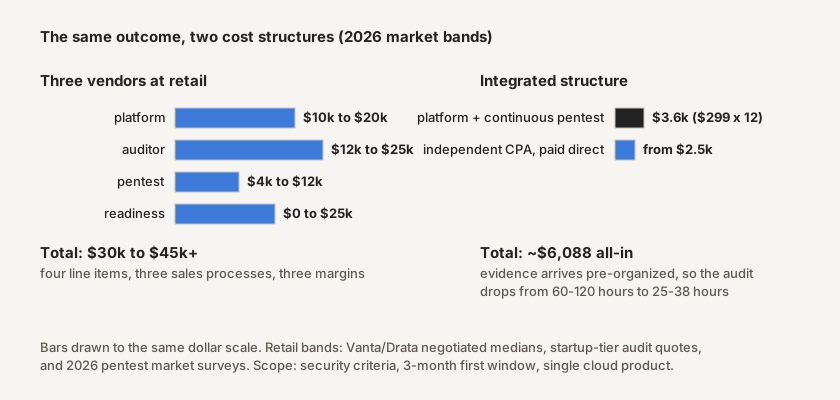
The same headline number is a different product when the testing was bought separately: the test runs all year on its own subscription, evidence arrives pre-mapped, and every CPA hour goes to the audit. That is how an attestation prices low without becoming a mill, and why we will not sell a bundle with the opinion inside it. See does SOC 2 require a penetration test for the timing rule that trips first-time buyers, and penetration testing cost for where day rates come from.
Our numbers, in the open
| Under 10 people | 10 people or more | |
|---|---|---|
| Platform, controls, monthly pentest | $299/mo, or $2,990/yr | $499/mo, or $4,990/yr |
| CPA attestation, paid direct to the firm | from $2,500 | from $2,500 |
| First year, all in | $6,088, or $5,490 annually | $8,488, or $7,490 annually |
| Human-led pentest, if you want one | $2,999 per engagement | $2,999 per engagement |
Why the attestation is not billed through us
Two things to notice. The attestation is paid directly to the independent CPA firm, never through us, because a fee moving between the platform and the auditor is exactly what compromises the independence the report depends on. And the monthly penetration test is inside the subscription, not an add-on, which is the line item the cheapest platform-plus-captive-auditor offers leave out entirely.
Against the traditional stack of a platform, a pentest firm and a CPA, the same first year runs $30,000 to $45,000. Our SOC 2 offer explains what we hand the auditor and what stays their call, and a 20-minute call will settle an unusual situation faster than a quote form.
Frequently asked questions
How much does a SOC 2 audit cost in 2026?
From a traditional CPA firm, 7,000 to 50,000 dollars for the examination alone, and most single-product startups are quoted 15,000 to 30,000. The whole first-year program runs 15,000 to 60,000 once the platform and the penetration test are counted. A deliberately minimal scope changes the arithmetic: Security criteria only, a three-month window, one product and one cloud account, evidence already mapped, and the audit line can start near 2,500 dollars.
How much does SOC 2 cost for a startup under 10 people?
Our published all-in is 6,088 dollars for year one: 299 dollars a month for the platform, the controls and a penetration test every month, plus a CPA attestation from 2,500 dollars paid directly to the independent firm. Paid annually it is 5,490. For comparison, the traditional three-vendor stack of platform plus pentest firm plus CPA runs 30,000 to 45,000 for the same first year.
How much does SOC 2 certification cost?
There is no SOC 2 certification, so the question has no direct answer. SOC 2 is an attestation report signed by a licensed CPA firm, not a certificate issued by a body. Searches for certification cost mean the audit fee plus whatever it took to become auditable: the platform, the evidence work and usually a penetration test. Any vendor selling you a SOC 2 certificate is describing something that does not exist.
Why is a Type 2 more expensive than a Type 1?
A Type 1 tests whether controls are designed properly on a single date. A Type 2 tests whether they actually operated across a window, which means sampling evidence over that period, so there is more fieldwork. Type 1 typically runs 40 to 60 percent of the Type 2 fee. Buying a Type 1 first usually costs more in total, because you pay two engagement fees and two report productions to end up where a Type 2 alone would have put you.
Can a SOC 2 audit legitimately cost under 5,000 dollars?
The examination alone, yes, if the scope is genuinely small and someone else already did the evidence work. What cannot be legitimate is one cheap bundled fee covering both the audit and the penetration test. At a 150 dollar hourly rate, a 2,500 dollar bundle buys roughly 16 hours for both jobs, which is why those reports converge on templated no-exception findings. The 2026 audit-mill scandal, 533 near-identical reports across 455 companies, is what made enterprise reviewers hostile to that tier.
How can HackZero charge 299 dollars a month when the usual stack costs 30,000?
Stack ownership. The attack agents, the exploitation toolchain and the reporting are all built in-house, so the marginal cost of a run is compute plus senior review rather than tester-weeks, and the day-rate formula the market prices on stops applying. AI does the continuous coverage no human team could afford monthly, hackers stay in the loop to confirm findings actually exploit and to write the report reviewers read, and because the same product holds the controls and the monitoring, evidence reaches the auditor pre-mapped instead of costing them billable hours to chase. The prices are published rather than quoted: 299 a month under ten people, 499 at ten or more, and the CPA attestation from 2,500 paid directly to the independent firm, which is what keeps the opinion independent. The honest catch is that the subscription is AI-led with human validation; hackers driving a named engagement is 2,999 per engagement on top.